Tesla Cybercab Hijacks Austin Streets, Feds Want Answers!
KEY TAKEAWAYS
- •Tesla began testing its driverless Cybercab on public roads in Austin, Texas, without steering wheels or pedals
- •Viral videos showed pedestrians testing the vehicle, close calls, traffic delays, and emergency stops
- •The US National Highway Traffic Safety Administration (NHTSA) opened an audit into whether the vehicle meets federal standards
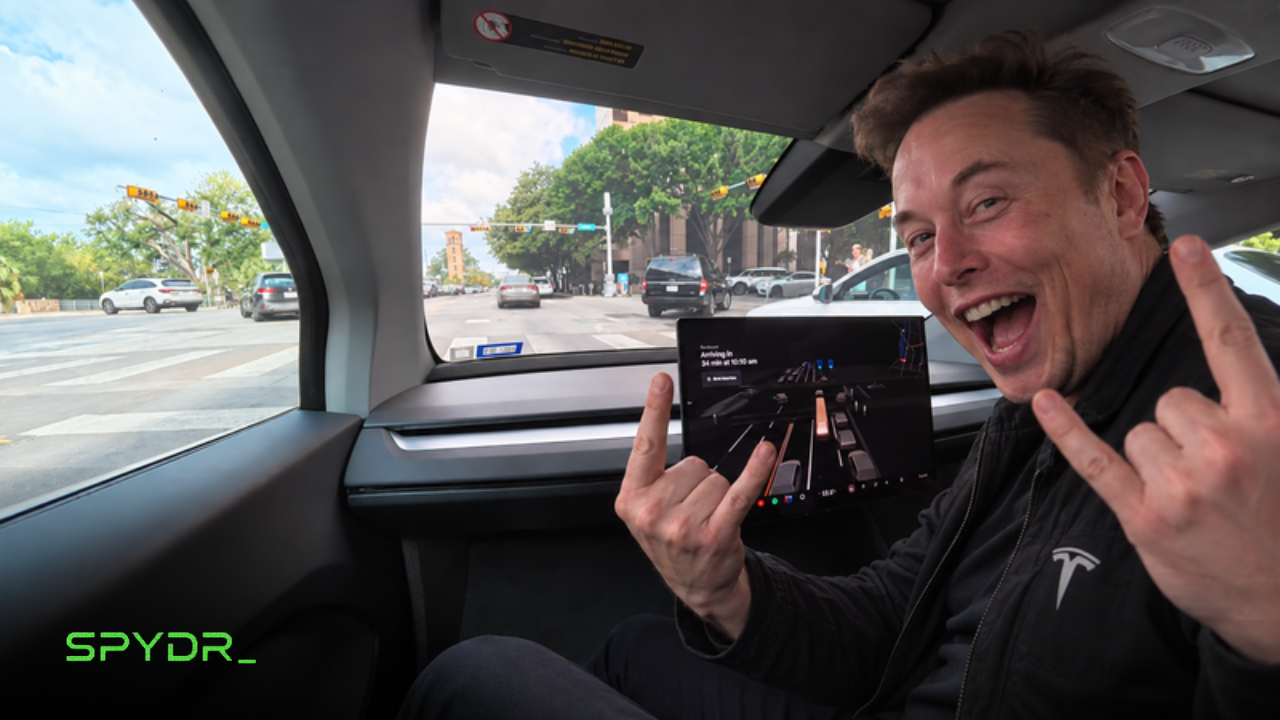
Elon Musk takes the Cybercab for a spin as Tesla's driverless experiment hits Austin streets.
AI-generated visual. Promptographer: Max Nthite
Tesla has finally unleashed its futuristic Cybercab on the streets of Austin, Texas, and within days, the internet was flooded with videos of the vehicle navigating traffic, confusing pedestrians, and being pushed to its limits by curious locals.
Unlike standard Teslas running Full Self-Driving software, the Cybercab has no steering wheel, no pedals, and no driver in the front seat.
It is designed from the ground up as a pure autonomous robotaxi.
Tesla has roughly 45 Cybercabs registered with the Texas DMV, while rival Waymo operates approximately 4,000 unsupervised vehicles across 14 cities.
Tesla is not the market leader, not even close. And as soon as the car hit the streets, people couldn't resist stress-testing it.
Tesla Cybercab Safely Transports Husband & Wife
One of the best early looks at the experience comes from Tesla creator Sawyer Merritt, who filmed an entire ride through Austin with his wife.
The Cybercab quietly drives itself around the city while the passengers sit back and watch the machine do the driving.
It looks futuristic as fuck. It also looks surprisingly normal. Until humans start getting involved.
Pedestrian Pranks Cybercab
A viral video this week showed a man repeatedly jumping in front of a moving Cybercab, forcing it to slam on its brakes.
The car stopped every single time. It did its job.
But the incident raised a real question: what happens when a prankster causes a Cybercab to brake suddenly, and the car behind it doesn't stop in time?
The Cybercab's safety-first programming could create a new headache for insurance companies if autonomous vehicles make frequent emergency stops in mixed human traffic.
Cybercab Could Cause Serious Traffic Jams
Another video shows the Cybercab hesitating before making a 90-degree turn into another lane.
A frustrated driver in a bakkie eventually gets tired of waiting, drives around the Cybercab and merges ahead of it.
A robotaxi has to calculate the risk before committing. If it waits too long, human drivers get impatient and start making their own decisions around it.
Your Phone Is The Key To The Cybercab
One Cybercab user, Owen Sparks, deliberately tested what happens if your phone dies while the robotaxi is on its way to collect you.
The answer? You can't get in.
That's because your phone is effectively part of the key to the Cybercab. If your phone dies before you get inside, you've got a very expensive gold car sitting outside that you can't unlock.
Cybercab Gets Thumbs Up From Wheelchair User
Not everything about the early Cybercab experience is weird.
A video shows a wheelchair user getting into the vehicle while his brother loads the wheelchair into the trunk.
The Cybercab's low step-in height and large rear cargo area could make it an interesting accessibility option for some people with disabilities.
Now The US Government Wants Answers
The biggest obstacle to Tesla's Cybercab might not be pedestrians, impatient drivers or dead phones. It might be Washington.
The National Highway Traffic Safety Administration opened an Audit Query into Tesla's self-certification of the Cybercab immediately after its Austin deployment.
The regulator is examining whether the unusual vehicle complies with federal safety standards despite having no conventional steering wheel or pedals.
Max Nthite
Founder & Editor-in-Chief | SPYDR Magazine • HUMAN
Max Nthite is the Founder of Spydr Media and Editor-in-Chief of SPYDR Magazine.